Design Studio 21: Graphic Space
This class will consider the challenges and unique opportunities created when exhibiting Graphic Design. In order to do so we will create a series of portable Graphic Design exhibitions about contemporary graphic designers, culminating in a group show we curate at SNU Powerplant at the end of the semester and a subsequent catalog. Our activities over the semester will include: curation, exhibition design, spatial design, web design, furniture design, book design, graphic identity design and more.
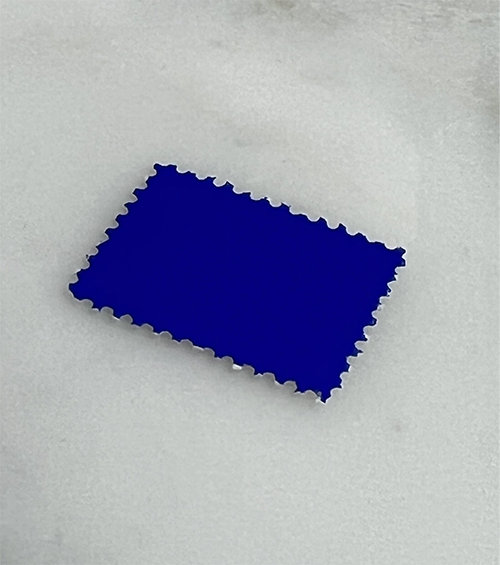
Postage Stamp, Yves Klein
Graphic Design occupies a unique position within exhibition-making, presenting both challenges and opportunities within an exhibition context. Traditionally, graphic design objects—books, websites, apps, and other printed matter—are created to be ephemeral, mass-produced, and widely circulated. Exhibitions, by contrast, often prioritize objects that are singular, static, or enduring, creating a tension between the nature of graphic design and the conventional expectations of exhibitions.
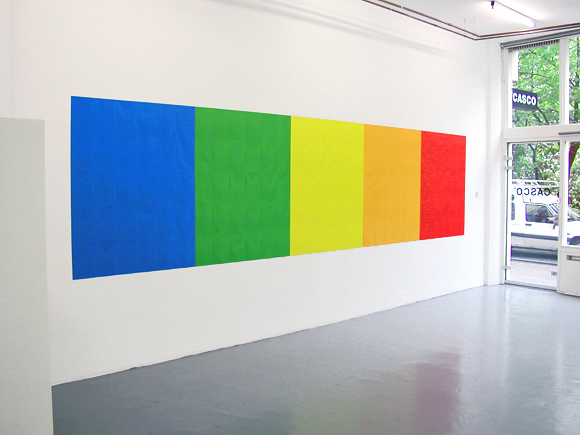
Kelly 1:1, Experimental Jetset
Yet, graphics are essential to exhibitions, serving as a critical part of the Exhibitionary Apparatus. From exhibition identities and promotional materials to wayfinding systems, graphic design plays a vital, albeit often background, role in exhibitions. While artists frequently incorporate graphic design processes into their works, graphic design itself is rarely the central subject of exhibitions or transcends its traditional boundaries in exhibition-making.
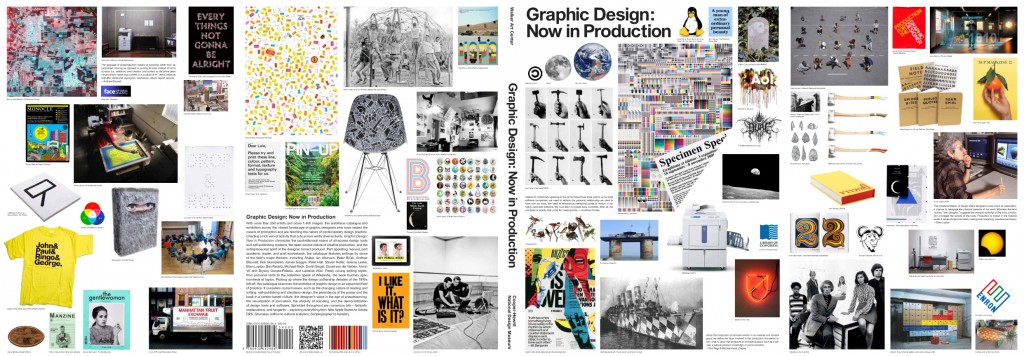
Graphic Design Now in Production, Walker Art Center
This course invites students to take on dual roles as curators and designers, exploring the untapped potential of graphic design as an exhibition subject. Together, we will push the boundaries of how graphic design can be translated into exhibitions in innovative and unconventional ways. Through a series of curated projects, students will create small tabletop exhibitions and culminate in a larger group show featuring innovative graphic design from around the world that challenges traditional exhibition formats.

Colors Shapes Movements, Felice Varini at DDP
To inform our work, we will draw on a range of historical and contemporary references. These include spatial and "Supergraphics," participatory exhibitions, performance-based graphic design works, and projects that blur the lines between graphic design and exhibition. Examples such as Yves Klein’s IK Blue unofficial postage stamps used for promoting his exhibitions, Felice Varini’s immersive super graphics, Åbäke’s pocket-sized exhibition-publication All The Knives, Any Printed Story On Request, LUST’s physical-digital experiments like Posterwall, the performative works of The Rodina, and Chia Amisola’s website-as-performance will inspire and guide us.
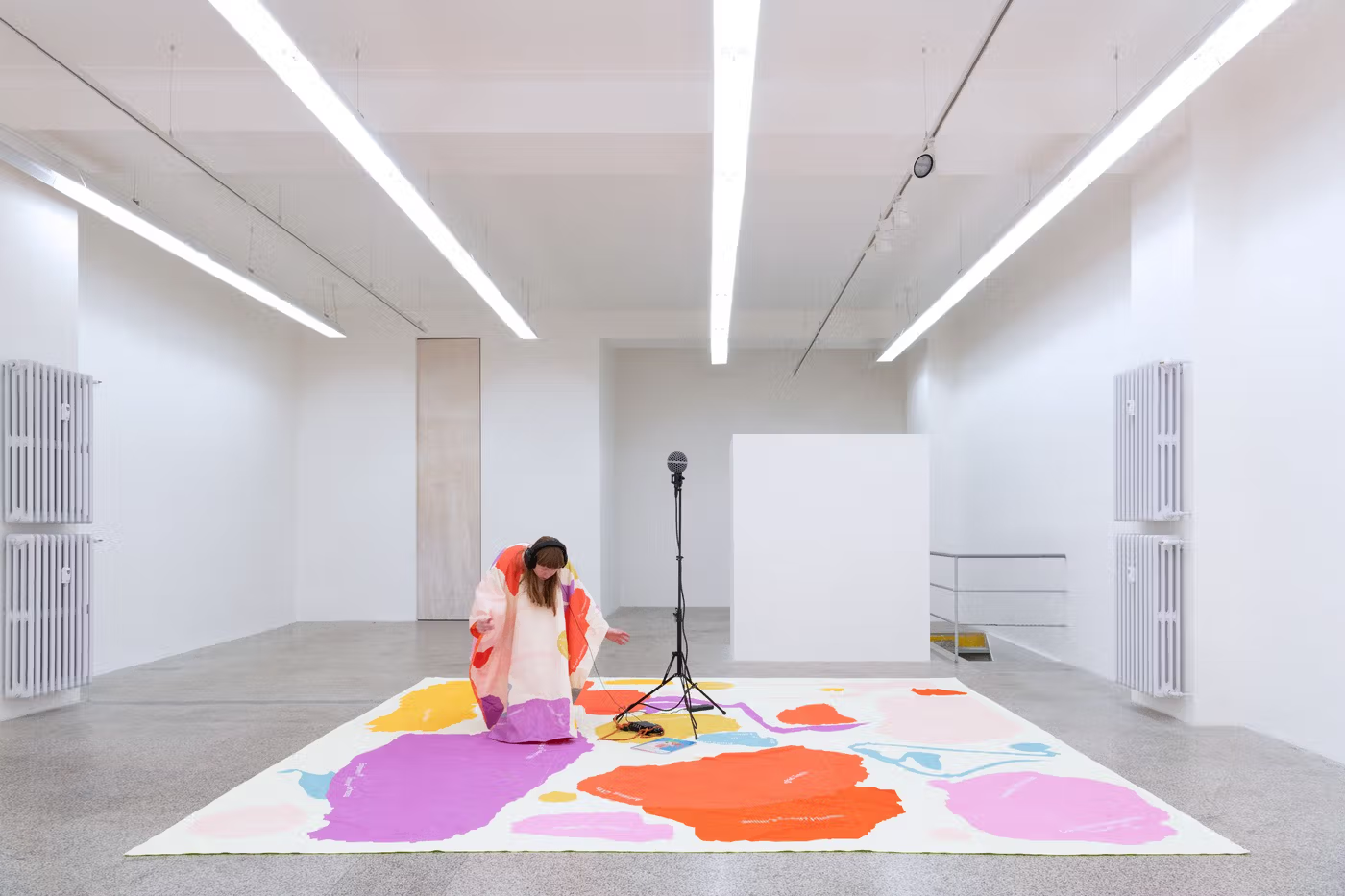
Elements of Style, The Rodina
By the end of the course, students will produce three tabletop exhibitions, a group exhibition at Powerplant complete with programming such as artist talks or workshops, and an exhibition catalog. Collectively, these outcomes aim to expand the possibilities for exhibiting graphic design and reframe how we think about the relationship between graphic design and exhibition-making.
Note: This class will require students to participate outside of classtime, including during the weekend, of the group exhibition at Powerplant from June 4-10.
Learning Outcomes
- An expanded perspective on exhibiting graphic design
- New techniques for creating and displaying work in an exhibition context
- Publication design experience
- Time management and event planning skills
- Insights into the editorial process and planning
- Tags: Graphic Design, Exhibition Design, Publication Design, Visual Communication, Editing, Collaboration, Transdisciplinary, Relational Design
Requirements
Students should be comfortable using design software and producing graphic outcomes (these can range from digital outcomes like webpages or videos, to physical materials such as books, posters, textiles, etc.)
This class focuses more on long term outcomes with sustained effort. If you cannot commit to making work on time, real (printed, coded, etc.), and to a high caliber, this will be reflected in your grade. We must keep deadlines — even preliminary review deadlines — to stay on schedule. Furthermore, the work we produce will be shown in a public way – so it cannot exist solely as sketches in your computers or rough prototypes.
As a minimum the course requires ability to use the adobe creative suite (indesign + photoshop primarily) and figma!!! If you are concerned about these, please talk with me about it.
Equipment Requirements
- Personal Laptop
- Phone, digital camera, scanner, screen capture etc.
- Access to printers and other means of production
- Adobe Creative Suite
- Figma
Readings
- There will be routine readings with discussions taking place in class and occassionally online. All students will be required to pose one question and respond to another students question about each reading.
Class Activities
The following activities will take place in-person and online via a number of platforms:
- Reading discussion
- Topic lecture/discussion
- Project critique/discussion
- Group exercises
- A Weekend Workshop
- One-on-one meetings
- Group meetings
Grading
- 60% ... Projects (There will be 2 groups project this semester, which will be evaluated through a combination of instructor and self-evaluation)
- 10% ... Assignments (Exercises, readings, etc.)
- 10% ... Final Exhibition Participation
- 20% ... Attendance + Participation/Attitude (Being present and active in class via discussion, and preparation)
Letter grades represent the following:
A = excellent;
B = good;
C = satisfactory;
D = unsatisfactory;
F = failure.
Grading Criteria
Individual project grades and final course grade takes into consideration:
- Participation (attendance, engagement in critique, pro-active involvement through the demonstration of discussion and inquiry)
- Process (exploration, iteration, research)
- Concept (thought, originality, creativity, and criticality)
- Design (does the work function as intended, does it communicate, is there clarity of information and intent)
- Presentation (quality of craft, attention to detail, professionalism)
Attendance
Students who are absent for over 1/3 of the class will receive a grade of 'F' or 'U' for the course. (Exceptions can be made when the cause of absence is deemed unavoidable by the course instructor.)
Plagiarism
Students are expected to generate their own work and ideas. Since, this class focuses on a range of ideas including appropriation, there can be some gray area about originality in this context. If you are concerned about the authorship of your work, please discuss with chris.
Submitting your work and Class Archive
As a final deliverable, please send a .zip file with documentation of your work over the semester and send to chris via wetransfer by Weds June 25.
Credits
This website runs on Kirby and was adapted from a site developed by Laurel Schwulst.